The Vengerian Language Explained: Inside Hungarian Vocabulary and Grammar
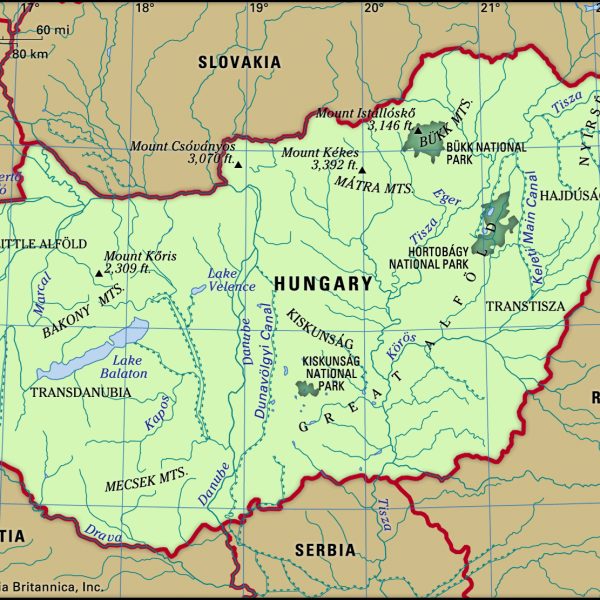
Ask a Russian or a Ukrainian speaker what language they speak in Budapest and the answer is vengerskiy. That Slavic exonym is where the word Vengerian comes from, and it points at one of the strangest and most rewarding languages in Europe: Hungarian. It is spoken by about 13 million people, it is the official language of a country of 9.6 million, and it is related to almost nothing around it. Everything that makes it hard is also what makes it interesting.
An island in an Indo-European sea
Hungary is surrounded by Slavic, Germanic and Romance neighbours. The Hungarian language belongs to none of those families. It is Finno-Ugric, a branch of the Uralic languages, and its nearest significant relatives are Finnish and Estonian, spoken more than a thousand kilometres away. Even that relationship is distant. A Finn and a Hungarian share a handful of ancient roots for fish, hand and water, and nothing else a traveller could use. The Magyar tribes carried the language into the Carpathian Basin around 895 CE, and it has held that ground ever since, absorbing Turkic, Slavic, German and Latin vocabulary without ever surrendering its structure.
That structure is the reason Hungarian keeps appearing on lists of the hardest languages to learn for English speakers. The United States Foreign Service Institute puts it in its highest difficulty tier, alongside Finnish, Polish and Turkish, at roughly 44 weeks of full-time study to reach professional working proficiency. Not because the sounds are hard, but because the machinery underneath is unfamiliar.
Words that stack instead of sit in order
Hungarian is an agglutinative language, which means grammatical information gets glued onto the end of a word rather than expressed with separate prepositions and articles. English says "in my houses". Hungarian says hazaimban: the root haz, plus a possessive, plus a plural, plus a case ending, all inside one word. Where English needs five words, Hungarian needs one, and word order is left free to do something else entirely.
What it does instead is mark emphasis. In Hungarian, the slot immediately before the verb is the focus position, and whatever you put there is the thing you are asserting. Move the same three words around and you change what the sentence is arguing about, not who did what to whom. That is why translation engines produce Hungarian that is technically parseable and emotionally wrong: they get the case endings right and put the emphasis in the wrong place.
Then there are the cases. Depending on which grammarian you ask, Hungarian has between 18 and 27 of them, many of them spatial with a precision English does not attempt. There is a separate ending for onto a surface, on a surface, and off a surface, and another set for into, inside and out of an enclosed space. A Hungarian speaker cannot say "I put the book on the table" without committing to whether the book arrived there or was already resting there.
Vowel harmony, the invisible rule
The single feature learners underestimate is vowel harmony. Hungarian vowels split into front and back groups, and every suffix has at least two forms so that it can match the vowels of the root it attaches to. The dative ending is nak after a back-vowel word and nek after a front-vowel one. There is no choice, no exception worth mentioning, and native speakers apply it without ever having been taught it. Get it wrong and you are instantly identifiable as a foreigner, even when every other part of the sentence is correct.
The Hungarian alphabet handles all this with 44 letters, including digraphs like cs, gy, ny and sz and the trigraph dzs, plus long and short versions of most vowels. Spelling is close to fully phonetic, which is the one genuine mercy the language extends to beginners.
A vocabulary built from borrowings and inventions
The lexicon tells its own history. Turkic loanwords from the centuries before the conquest cover livestock and agriculture. Slavic borrowings arrived with Christianity and cover the church, the calendar and the kitchen. German words came with the Habsburgs and clustered around trade and the army. Then, in the first half of the nineteenth century, the nyelvujitas or language reform movement, led by Ferenc Kazinczy, deliberately manufactured roughly ten thousand new Hungarian words to replace Latin and German terms in science, law and literature. Many of them stuck. Zongora for piano and vonat for train are both engineered words that entered ordinary speech and never left, which is a rare thing in any language.
What it costs to work with
All of this has commercial consequences. A Hungarian translation that starts from an English source almost always comes out longer in word length and shorter in word count, which wrecks fixed-width interface layouts and print columns. Anyone who has tried to translate Hungarian to English in software finds that machine output collapses exactly where the language is most itself: the focus position vanishes, the case endings get flattened into generic prepositions, and the result reads like a police report.
Human translators working into Hungarian tend to describe the job as restructuring rather than substitution, and the cognitive shift is real. The research on how adult brains rebuild themselves around a second grammar is summarised well in this piece on the psychology of learn Hungarian and second-language acquisition.
The r/hungarian community is where most learners end up, comparing suffix charts and arguing about the definite conjugation, the rule that gives Hungarian two entire verb paradigms depending on whether the object is definite. No language spoken by 13 million people should be this complicated. Hungarian is, and it is not apologising.